
Garage Door Repair Costs in South Africa (2026 Price Guide)
If your garage door suddenly won't open, has a broken spring, damaged cables or a faulty motor, one of the first questions you'll probably ask is:
"How much is this going to cost to repair?"
The answer depends on several factors, including the type of garage door you have, the parts that need replacing, the complexity of the repair and whether emergency call-out services are required.
At The Garage Door Company, we've repaired thousands of garage doors across Gauteng, ranging from simple roller replacements to complete sectional garage door rebuilds and motor installations. One thing we've learned is that many homeowners receive vastly different quotations because they don't fully understand what the repair involves.
This comprehensive pricing guide has been created to help South African homeowners make informed decisions before requesting quotations.
Inside this guide you'll discover:
- Typical garage door repair costs in South Africa
- What influences repair prices
- The most common garage door repairs
- When a repair is better than replacing the entire door
- How regular servicing can reduce future repair costs
- Questions you should ask before accepting a quotation
- Tips for avoiding unnecessary repairs
Whether you own a sectional garage door, roll-up garage door or automated garage door with an electric motor, this guide will provide a realistic overview of the costs involved.
Disclaimer: The prices shown throughout this guide are intended as general South African market estimates. Actual quotations may vary depending on your location, garage door type, replacement parts required, labour involved and the overall condition of the garage door.
Average Garage Door Repair Costs in South Africa
The table below provides an overview of the most common garage door repairs and their typical price ranges.
| Garage Door Repair | Typical Price Range |
|---|---|
| Garage Door Service | R650 – R950 |
| Standard Call-Out & Inspection | R450 – R750 |
| Broken Spring Replacement | R1,400 – R3,200 |
| Garage Door Cable Replacement | R700 – R1,600 |
| Garage Door Roller Replacement | R700 – R1,500 |
| Garage Door Track Repairs | R1,000 – R2,800 |
| Garage Door Off-Track Repair | R1,000 – R2,500 |
| Garage Door Motor Repairs | R850 – R2,800 |
| New Garage Door Motor Installation | R4,500 – R8,500+ (including motor depending on brand) |
| Garage Door Remote Programming | R250 – R650 |
| Safety Beam Repairs | R600 – R1,600 |
| Garage Door Panel Repairs | From R1,500 |
| Emergency After-Hours Call-Out | Additional R500 – R1,500 |
These figures are intended as a guide only. Some repairs can cost less, while more complex jobs involving structural damage or specialist components may cost more.
Why Garage Door Repair Prices Vary
Many homeowners are surprised when they receive two quotations that differ by several thousand rand for what appears to be the same repair.
In reality, no two garage door repairs are exactly alike. A professional technician will assess the condition of the entire system before recommending the most appropriate repair.
Below are the biggest factors that influence garage door repair costs.
1. Type of Garage Door
Different garage door designs use different hardware, lifting systems and operating mechanisms.
Common garage door types in South Africa include:
- Sectional Garage Doors
- Roll-Up Garage Doors
- Tip-Up Garage Doors
- Aluminium Garage Doors
- Wooden Garage Doors
- Custom Garage Doors
For example, replacing torsion springs on a sectional garage door requires a different repair process to replacing components on a roll-up garage door. Aluminium garage doors may also require specialist replacement panels or hardware.
The design of the door directly affects labour time and replacement part costs.
2. What Has Actually Failed?
One of the biggest misconceptions is that the visible symptom is always the actual problem.
For example, a garage door that refuses to open could be caused by:
- A broken torsion spring
- Snapped lifting cables
- A seized bearing
- Faulty safety beams
- Incorrect motor limits
- Worn drive gears
- Electrical faults
- A disengaged manual override
Two garage doors with the same symptom may require completely different repairs, which is why a proper inspection is so important.
3. Replacement Parts
The quality of replacement parts has a significant impact on both the cost and the long-term reliability of the repair.
Professional garage door companies typically install:
- Heavy-duty springs
- Galvanised lifting cables
- Premium nylon rollers
- High-quality bearings
- Genuine motor components
- Manufacturer-approved accessories
While cheaper aftermarket parts may reduce the initial cost, they often have a shorter lifespan and may result in more frequent breakdowns.
4. Labour Requirements
Not every repair takes the same amount of time.
For example: Programming a remote may take only a few minutes, while replacing torsion springs requires specialist tools, careful tensioning and thorough safety testing.
More complex repairs may require:
- Two technicians
- Additional safety precautions
- Door balancing
- Motor recalibration
- Multiple replacement components
Labour is therefore one of the biggest contributors to the overall repair cost.
5. Garage Door Motor Brand
Automated garage doors are fitted with a variety of motor brands, each with its own spare parts and servicing requirements.
Popular garage door motor brands in South Africa include:
Some faults can be repaired economically by replacing individual components, while older or discontinued motors may require complete replacement due to limited spare part availability.
6. Emergency Repairs
Garage doors don't always fail during business hours.
Many companies charge additional fees for:
- Evenings
- Weekends
- Public holidays
- Same-day emergency call-outs
Emergency rates reflect the additional travel, technician availability and after-hours support required to restore your garage door as quickly as possible.
7. Your Location
Travel distance also plays a role in pricing.
Repairs in major metropolitan areas may differ from repairs in smaller towns or outlying areas where technicians need to travel longer distances.
Some companies include travel within their normal service areas, while others may charge additional travel fees for locations outside their coverage zone.
Repair or Replace Your Garage Door?
One of the biggest concerns homeowners have is whether it's worth repairing an older garage door or replacing it altogether.
In many cases, a professional repair is significantly more affordable than installing a brand-new garage door.
If the door panels, tracks and frame remain structurally sound, replacing a worn component such as a spring, cable or motor can restore safe and reliable operation for many more years.
Repairing your existing garage door is often the best option when:
- Only one or two components have failed.
- Replacement parts are readily available.
- The door is structurally sound.
- The motor can still be repaired economically.
- The overall condition of the garage door is good.
Replacement may be the better long-term investment if:
- Multiple major components have failed.
- The door has extensive structural damage.
- Replacement parts are no longer available.
- The cost of repairs approaches the cost of a new installation.
- You want improved security, insulation or modern automation features.
A reputable garage door company should explain why they recommend a repair or replacement, giving you the information you need to make an informed decision rather than simply suggesting the more expensive option.
What You'll Learn Next
Now that you understand what influences garage door repair costs, we'll look at each type of repair in detail.
In the next section, we'll cover:
- Broken Garage Door Springs
- Garage Door Cable Repairs
- Garage Door Roller Replacement
- Garage Door Track Repairs
- Garage Door Off-Track Repairs
- Hinges and Brackets
For each repair, we'll explain:
- What the component does
- Common signs of failure
- Why it breaks
- Typical repair process
- Average repair cost
- Whether repair or replacement is recommended
- Tips to prevent the problem from happening again
By understanding each repair individually, you'll be better equipped to compare quotations, recognise potential problems early and make confident decisions about maintaining your garage door.
Common Garage Door Repairs Explained
Garage doors contain dozens of moving parts that work together every time the door opens or closes. Over time, normal wear and tear, weather conditions and daily use can cause certain components to wear out or fail.
Understanding what each part does and recognising the early warning signs can help you avoid more expensive repairs and improve the overall lifespan of your garage door.
Below are the most common garage door repairs carried out throughout South Africa.
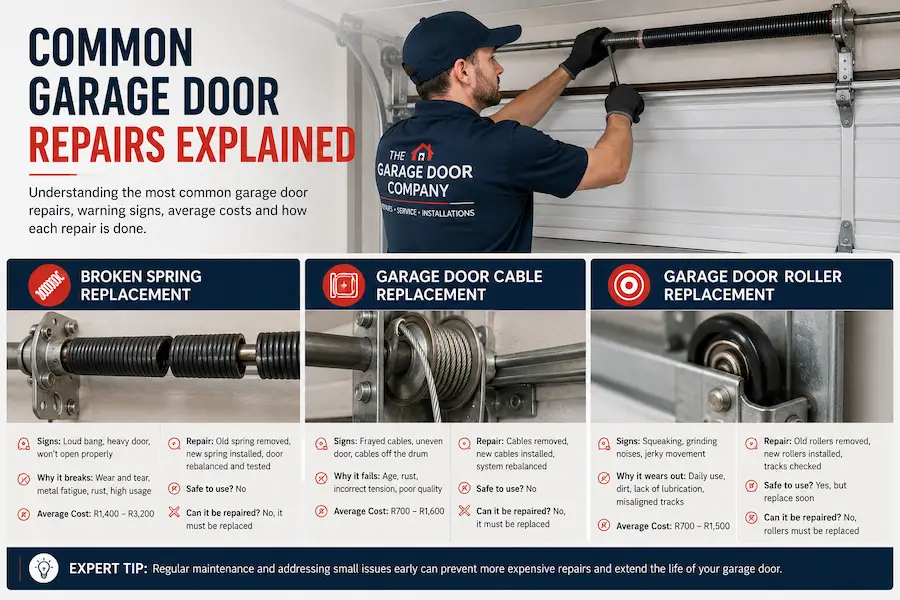
Broken Garage Door Spring Replacement
One of the most common garage door repairs is replacing a broken spring.
Garage door springs are responsible for counterbalancing the weight of the door, making it easy to lift manually or with an electric garage door motor. Without properly functioning springs, the full weight of the door is placed on the motor and lifting system.
A typical residential sectional garage door can weigh anywhere from 70 kg to well over 150 kg, depending on its size and construction. The springs carry most of this weight, which is why they experience significant stress over thousands of operating cycles.
Signs Your Garage Door Spring Has Broken
Some of the most common symptoms include:
- Garage door won't open properly.
- Loud bang from the garage.
- Door feels extremely heavy.
- Door opens unevenly.
- Garage door motor struggles.
- Visible gap in the torsion spring.
- Door only opens a few centimetres before stopping.
Many homeowners initially think their garage door motor has failed, when in reality the motor is simply unable to lift the full weight of the door because the spring has broken.
Why Garage Door Springs Break
Garage door springs are consumable components.
Like tyres on a vehicle, they eventually wear out after repeated use.
The most common causes include:
- Normal wear and tear.
- Metal fatigue.
- Rust and corrosion.
- Poor maintenance.
- Incorrect spring tension.
- Inferior quality springs.
- High daily usage.
Homes where the garage door is used as the main entrance often experience faster spring wear due to the increased number of opening and closing cycles.
Should You Continue Using The Door?
Generally, no.
Continuing to operate a garage door with a broken spring can:
- Damage the garage door motor.
- Cause cables to come off the drums.
- Place excessive strain on hinges and rollers.
- Increase the risk of further component failure.
- Create a serious safety hazard.
If you suspect a broken spring, it's best to stop using the door until it has been inspected by a qualified technician.
How Professionals Replace Garage Door Springs
Spring replacement is one of the most dangerous garage door repairs because torsion springs are under significant tension.
A professional technician will generally:
- Inspect the complete lifting system.
- Secure the garage door safely.
- Release spring tension using specialist winding bars.
- Remove the damaged spring.
- Install the correct replacement spring.
- Rebalance the garage door.
- Check cable tension.
- Lubricate moving components.
- Test manual operation.
- Test motor operation.
- Perform final safety checks.
Correct balancing is essential. A properly balanced garage door should remain relatively stable when lifted halfway manually, rather than dropping closed or shooting upwards.
Can Springs Be Repaired?
In almost every case, no.
Once a torsion or extension spring breaks, replacement is the only safe and reliable solution.
Attempting to weld or repair a broken spring is unsafe and is not recommended.
How To Extend Spring Life
Although springs eventually wear out, regular maintenance can help maximise their lifespan.
Simple maintenance includes:
- Annual servicing.
- Lubricating moving components.
- Keeping the door correctly balanced.
- Replacing worn rollers before they create unnecessary strain.
- Addressing unusual noises promptly.
Preventative maintenance is often far less expensive than emergency repairs after a complete spring failure.
Garage Door Cable Replacement
Garage door cables work together with the springs to safely lift and lower the door.
While the springs carry most of the door's weight, the cables transfer that lifting force to the bottom of the door.
Because they are constantly under tension, cables gradually wear over time.
Signs Of Worn Or Broken Garage Door Cables
You may notice:
- Frayed steel strands.
- Loose cables.
- Door lifting unevenly.
- Door jams halfway.
- Cables slipping off the drums.
- Visible rust.
- One side of the door hanging lower.
Damaged cables should never be ignored.
A snapped cable can cause the door to become unstable, placing additional strain on the remaining components.
Why Garage Door Cables Fail
Common causes include:
- Age.
- Rust.
- Incorrect spring tension.
- Poor-quality cables.
- Worn cable drums.
- Misaligned tracks.
- Lack of maintenance.
In many cases, cable failure occurs shortly after spring failure because both components experience similar levels of wear over time.
How Cable Replacement Is Performed
Professional technicians will typically:
- Secure the garage door.
- Release spring tension safely.
- Remove damaged cables.
- Inspect cable drums.
- Install new lifting cables.
- Rebalance the system.
- Test safe operation.
Replacing only the cable without checking the rest of the lifting system may lead to recurring problems if underlying issues are not addressed.
Can You Replace Garage Door Cables Yourself?
It is generally not recommended.
Garage door cables operate under significant tension due to the springs.
Improper removal can result in serious injury or damage to the garage door system.
Garage Door Roller Replacement
Garage door rollers allow the door to move smoothly along the tracks during opening and closing.
Over time, rollers wear down, bearings become noisy and movement becomes less efficient.
Worn rollers not only create noise but also place unnecessary strain on the garage door motor and lifting system.
Common Signs Of Worn Rollers
Watch for:
- Squeaking noises.
- Grinding sounds.
- Jerky door movement.
- Door sticking.
- Flat spots on rollers.
- Cracked nylon wheels.
- Excessive vibration.
Many homeowners assume the garage door motor is failing when the real cause is simply worn rollers creating additional resistance.
Why Rollers Wear Out
Rollers naturally deteriorate due to:
- Daily use.
- Dust and dirt.
- Lack of lubrication.
- Poor bearing quality.
- Misaligned tracks.
- Heavy garage doors.
Higher-quality sealed-bearing nylon rollers generally provide quieter operation and longer service life than inexpensive steel alternatives.
Roller Replacement Process
A technician will usually:
- Inspect track alignment.
- Remove damaged rollers.
- Replace worn hinges if necessary.
- Install new premium rollers.
- Lubricate moving components.
- Check door balance.
- Test smooth operation.
Replacing rollers before complete failure can often prevent more expensive track repairs later.
Expert Tip
One of the most common mistakes homeowners make is waiting until the garage door becomes extremely noisy before arranging a service.
In many cases, replacing worn rollers early can reduce strain on the entire garage door system, improve safety and extend the lifespan of the springs, cables and garage door motor.
Disclaimer: Prices shown throughout this guide are intended as general South African market estimates. Actual quotations may vary depending on your location, garage door type, replacement parts required, labour involved and the overall condition of the garage door.
Garage Door Track Repairs & Maintenance
Garage Door Track Repairs
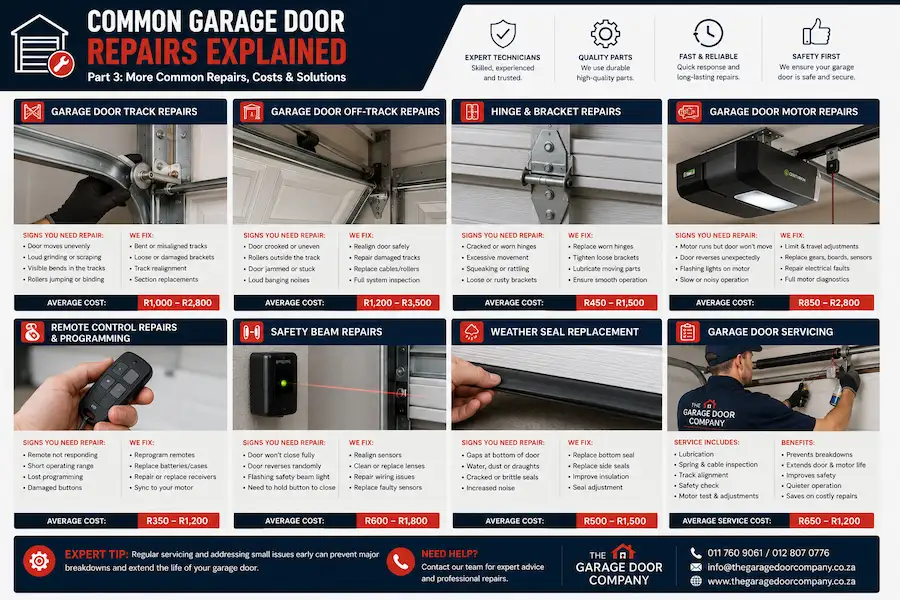
Garage door tracks guide the rollers and keep the door moving safely and smoothly. When tracks become bent, loose or misaligned, even a high-quality garage door can struggle to open and close properly.
Track problems often start gradually but can quickly become more serious if ignored, potentially causing the door to come off its tracks or place unnecessary strain on the garage door motor.
Signs Your Garage Door Tracks Need Repair
Common warning signs include:
- Door moves unevenly.
- Loud scraping or grinding noises.
- Rollers jumping or binding.
- Visible bends in the tracks.
- Gaps between rollers and tracks.
- Garage door shakes while operating.
- Door gets stuck halfway.
If your garage door appears crooked while opening, damaged or misaligned tracks are often the cause.
Why Garage Door Tracks Become Damaged
Track damage can occur due to:
- Accidental vehicle impact.
- Worn rollers.
- Loose mounting brackets.
- Normal wear over time.
- Poor installation.
- Heavy impact from a broken spring.
- Corrosion and rust.
Even a small bend can prevent the rollers from travelling smoothly.
Can Bent Tracks Be Repaired?
It depends on the severity.
Minor bends can often be professionally straightened and realigned.
However, severely damaged, twisted or cracked tracks usually require replacement to restore safe operation.
How Track Repairs Are Performed
A technician will generally:
- Inspect the complete track system.
- Check track alignment.
- Tighten mounting brackets.
- Repair or replace damaged sections.
- Replace worn rollers if necessary.
- Lubricate moving parts.
- Test door balance.
- Verify smooth operation.
Proper track alignment is critical. Even a few millimetres of misalignment can significantly affect the performance of your garage door.
Garage Door Off-Track Repairs
A garage door that has come off its tracks should never be forced open or closed.
An off-track garage door is both a safety hazard and a sign that another underlying problem may have caused the failure.
Signs Your Garage Door Is Off Track
You may notice:
- One side lower than the other.
- Rollers outside the track.
- Door jammed in one position.
- Door appears crooked.
- Loud banging noises.
- Cable hanging loose.
- Door will not close properly.
Why Garage Doors Come Off Track
Common causes include:
- Broken cables.
- Broken springs.
- Bent tracks.
- Vehicle impact.
- Worn rollers.
- Loose brackets.
- Obstructions in the tracks.
Often, the visible problem is only part of the issue. A professional inspection is essential to identify and repair the underlying cause.
Professional Off-Track Repair
Repairs usually involve:
- Securing the garage door.
- Relieving spring tension if required.
- Repositioning rollers.
- Repairing damaged tracks.
- Replacing damaged rollers or cables.
- Checking spring balance.
- Testing safe operation.
Attempting to force an off-track garage door closed can cause significantly more damage.
Garage Door Hinge & Bracket Repairs
Garage door hinges and brackets connect the door panels and allow them to bend as the door travels through the curved section of the tracks.
Although relatively inexpensive components, worn hinges can affect the smooth operation of the entire system.
Signs Hinges Need Replacement
Look out for:
- Cracked hinges.
- Excessive movement.
- Squeaking.
- Loose bolts.
- Visible rust.
- Door panels separating.
- Jerky movement.
Common Causes
- Metal fatigue.
- Rust.
- High door usage.
- Poor maintenance.
- Loose fixings.
- Impact damage.
Replacing worn hinges early often prevents more expensive panel damage later.
Garage Door Motor Repairs
Not every garage door motor problem requires complete replacement.
In many cases, a professional repair or adjustment can restore reliable operation and extend the life of the motor.
Common Garage Door Motor Problems
Some of the most common issues include:
- Motor runs but door doesn't move.
- Door reverses unexpectedly.
- Remote control not responding.
- Door stops halfway.
- Loud clicking sounds.
- Flashing warning lights.
- Travel limits incorrectly set.
- Slow or inconsistent operation.
Why Garage Door Motors Fail
Common causes include:
- Worn drive gears.
- Faulty limit settings.
- Damaged circuit boards.
- Power surges.
- Worn capacitors.
- Failed safety sensors.
- Lack of servicing.
- Broken garage door springs placing excessive strain on the motor.
Many "motor failures" are actually caused by other faulty components, which is why a full inspection is recommended before replacing the motor.
Can Garage Door Motors Be Repaired?
Often, yes.
Depending on the make and model, technicians may replace:
- Drive gears.
- Logic boards.
- Capacitors.
- Limit switches.
- Safety sensors.
- Receiver modules.
- Internal belts or chains.
If replacement parts are no longer available or the motor is nearing the end of its service life, replacing the complete unit may be the more cost-effective option.
Popular Garage Door Motor Brands in South Africa
Technicians commonly work on:
- Centurion
- DigiDoor
- Gemini
- ET Systems
- Hansa
- DC Blue
- Nice
- LiftMaster
- Chamberlain
- FAAC
Availability of replacement parts can vary depending on the brand and model.
Garage Door Remote Control & Safety Beam Repairs
Garage door remote controls occasionally stop working due to flat batteries, accidental damage or loss of programming. Fortunately, many issues can be resolved quickly without replacing the entire motor.
Common Remote Control Problems
- Flat batteries.
- Remote not responding.
- Lost programming.
- Broken buttons.
- Water damage.
- Reduced operating range.
Sometimes the problem lies with the receiver inside the motor rather than the remote itself.
Modern garage door motors rely on infrared safety beams to detect people, pets and objects in the doorway. If the beam is interrupted or faulty, the garage door may refuse to close or reverse unexpectedly.
Signs of Faulty Safety Beams
- Door closes then immediately reverses.
- Flashing warning lights on the motor.
- Door only closes while holding the wall button.
- Inconsistent operation.
- Safety beam indicator lights off or flashing.
Common Causes
- Misalignment.
- Dirt on the lenses.
- Water ingress.
- Damaged wiring.
- Power supply issues.
- Failed sensors.
Fortunately, many safety beam issues are resolved by cleaning or realigning the sensors, making this one of the more affordable garage door repairs.
Weather Seal Replacement & Routine Servicing
Garage door weather seals help prevent dust, rain, insects and draughts from entering your garage.
Over time, exposure to sunlight and changing temperatures causes the rubber to harden, crack and lose its sealing ability.
Replacing worn weather seals improves weather protection, energy efficiency and the overall appearance of the garage door.
Why Regular Garage Door Servicing Saves Money
Many costly repairs begin as small maintenance issues that go unnoticed.
A professional garage door service typically includes:
- Lubricating moving components.
- Checking spring tension.
- Inspecting cables.
- Tightening hardware.
- Adjusting track alignment.
- Testing safety systems.
- Inspecting the garage door motor.
- Checking door balance.
- Identifying worn parts before failure.
Routine servicing helps reduce unexpected breakdowns, improves safety and often extends the lifespan of both the garage door and motor.
Expert Tip
Think of your garage door like your vehicle. Regular servicing may seem like an unnecessary expense, but it is often far more affordable than dealing with emergency repairs or replacing major components after they fail.
A well-maintained garage door operates more quietly, places less strain on the motor, and provides reliable performance for many years.
Disclaimer: Prices shown throughout this guide are intended as general South African market estimates. Actual quotations may vary depending on your location, garage door type, replacement parts required, labour involved and the overall condition of the garage door.